

Build A Takeaway Kit For Tapau From Things You Already Own
A typical tapau order can use five pieces of single-use packaging. This guide shows how to build a kit from a container, cutlery and a bag you already own, match it to your usual Malaysian orders and test it at home. It also covers asking hawkers to use your container, eating promptly in hot weather and a simple wash-and-repack routine that keeps the kit ready for next time.
It's 7pm on a weeknight at your usual mamak. You order char kuey teow and an iced teh tarik, both to tapau. The noodles arrive in a disposable box, with the sambal tied up in a tiny plastic bag. The drink comes in a knotted plastic bag with a straw, and everything goes into one more plastic bag for the trip home.
Count the pieces:
- 1 disposable box for the noodles
- 1 small plastic bag of sambal
- 1 tied plastic bag for the drink
- 1 straw
- 1 plastic bag to carry it all
That's five pieces of single-use packaging for one plate of noodles and a drink. Most of it is in the bin before the ice has melted. So what can you do differently, and how?
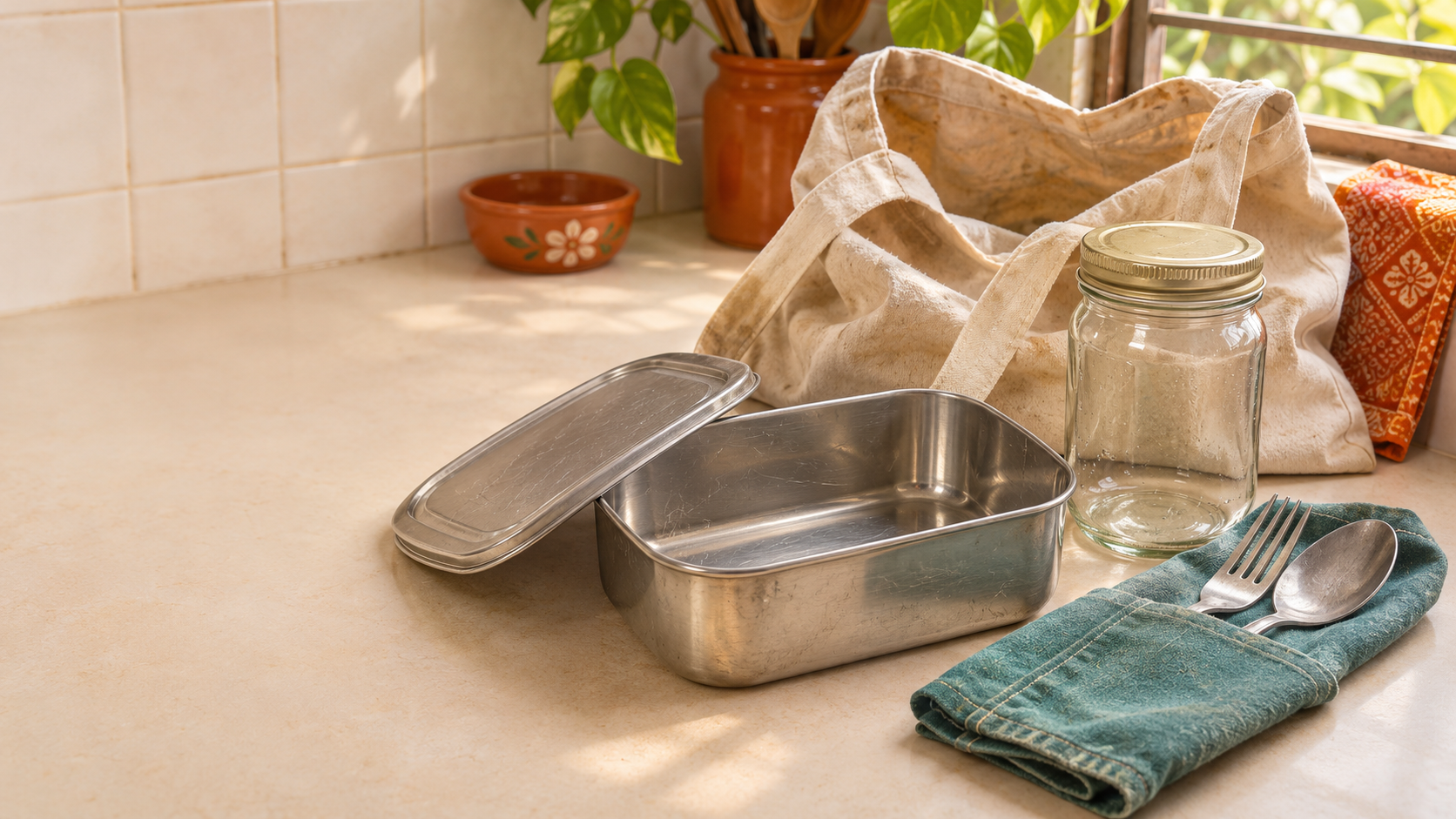
This takeaway kit guide is for anyone who buys tapau a few times a week and wants to use less packaging without buying new gear. The answer is a takeaway kit built from things already in your kitchen and cupboards: a clean container, a spoon and fork, and a bag you already own. No shopping needed.
Below, you'll gather, match, test, use, then wash and repack. Along the way you'll see why Penang's 2019 push to get people bringing their own containers struggled, and the one thing that makes the difference.
Why A Ready-packed Kit Makes Tapau Easier To Change
A habit with a name. Tapau is so much a part of daily life here that the word is now in the Oxford English Dictionary. It comes from Cantonese, means packing up food to take away, and was added in March 2025 as one of 12 new Malaysian and Singaporean English words, The Star reported (27 March 2025).
The waste behind the habit. Plastic and paper together made up 25.3% of the solid waste collected on Penang Island, the city council said when it relaunched its container campaign in 2022. The figure includes plastic and paper from all sources. Malay Mail's reporting on the Penang campaign gives the breakdown by material.
A lesson from Penang. The Penang Island City Council (MBPP) and the women's group PWMPP relaunched a 'Bring Your Own Container' campaign, asking people to bring containers when buying hawker food to take away. An earlier attempt in 2019 had struggled for a simple reason: plastic packaging was more convenient, according to Malay Mail.
Momentum elsewhere. Alam Flora's Ramadan campaign, 'Tapau Elak Sisa' (Pack to Avoid Waste), asks the public to bring their own containers or carriers. On 6 March 2026 it handed out 2,000 packs of bubur lambuk in reusable containers and tiered food carriers at the Precinct 3 Ramadan Bazaar in Putrajaya, The Malaysian Reserve reported (9 March 2026).
So why did Penang's first try struggle? Convenience decides the habit. Good intentions lose to whatever is easiest at 7pm. If the kit is already packed and hanging by the door, reusing becomes the easy option.
The best container for tapau isn't the newest one. It's the one that's already packed when you walk out the door.
Step 1: Check Your Cupboard Before Buying Anything
Open your cupboards first. Most homes already have more than enough for a kit. Look for:
- Lidded containers you use for leftovers
- The drawer of mismatched lids, where some may still find their partners
- An old school lunchbox
- Glass jars with screw-on lids
Don't forget the stacked carriers. Many households already have a tiffin carrier tucked away from family meals, kenduri or open houses. It holds several dishes at once, and the classic stainless steel version is sturdy and easy to wash.
Put each container through this quick check, which is based on guidance from Alberta Health Services and Food Standards Scotland.
| Check | What to look for | If it fails |
|---|---|---|
| Made for food | It was designed to hold food | Use it for pens, cables or sewing supplies instead |
| Good condition | No cracks, open seams or rust | Stop using it for food and give it a non-food job |
| Lid or closure | The lid fits snugly | Pair it with another lid, or use it only for dry snacks |
| Watertight (for wet dishes) | It passes the leak test in Step 5 | Use it only for dry dishes |
| Glass or ceramic | No chips or broken edges | Stop using it for food, because damaged containers can make food unsafe |
Reuse, don't throw out. If a container fails the check, give it a new job at home before you think about replacing it. A cracked lunchbox still makes a good drawer organiser.
Unsure about hot food? If you don't know whether a container can take hot dishes, use it for dry or room-temperature items such as kuih, roti or fruit.
Step 2: Match The Container To What You Usually Order
Write down your three most common tapau orders. Choose containers for those first. You can add more later.
| Typical order | What it needs | Container from home |
|---|---|---|
| Nasi lemak, roti canai, kuih | Dry, flat, room to spread out | A lidded lunchbox or shallow container |
| Mee rebus, curry, laksa, bubur | Watertight and deeper | A tight-sealing, heat-safe container |
| Mixed rice (nasi campur or economy rice) | Rice kept separate from the dishes | A tiered carrier or two containers |
| Iced teh tarik, kopi, sugarcane juice | Spill-proof, with room for ice | A bottle or tumbler you already own, or a lidded jar |
| Sambal or gravy on the side | Small and sealed | A small jar or condiment pot suitable for the food’s temperature |
Sizing tip: Choose a container close to the stall's usual portion. If it's too small, food spills over the edge. If it's far too big, the portion can look smaller.
In most homes, the best tapau container is the one you already reach for every day.
Step 3: Add Cutlery And A Napkin From The Drawer
- Cutlery: Take the everyday Malaysian set of a spoon and fork from home, plus chopsticks if you often order noodles.
- Wrap: Roll the cutlery in a cloth napkin, small tea towel or handkerchief. The cloth wipes up spills and stops the cutlery rattling.
- Straws: Decide whether you really need one. If you do, bring one you can wash at home. If not, just say no when you order.
No new gear needed: a spoon from the kitchen drawer does the same job as a travel cutlery set.
Step 4: Choose A Bag You Already Have
Good options include a tote from an event, a cloth bag, a sturdy shopping bag you've already reused or a spare compartment in your backpack. A good kit bag has:
- A flat base, so containers stay upright
- Fabric you can wash
- A size that suits how you travel, whether it hangs on a motorcycle hook, sits in a car footwell or goes with you on the LRT or MRT
Tip: Use this bag for the kit only, so it's always packed and ready.
Step 5: Test Your Takeaway Kit At Home Before The Next Outing
This 10-minute test run catches problems at home rather than at the stall.
- Leak test: Fill the container you'll use for wet dishes with cool water, close it and hold it upside down over the sink for 30 seconds. If it leaks, try another lid or keep that container for dry food.
- Pack test: Pack everything into the bag. Walk around the house or take the stairs and listen for rattling or tipping. Tuck the napkin into any gaps.
- Grab test: Hang the bag where you'll see it, then time yourself from picking it up to walking out the door. You shouldn't need any extra steps.
- Travel test: Try the kit on the transport you actually use, whether that's a motorcycle, car, bus or train.
- Choose a home spot: Decide where the kit lives, such as a hook by the door, a drawer at work or a bag that stays in the car. Store the containers clean, dry and empty.
If one part fails, change only that part. There's no need to rebuild the whole kit.
At The Stall: Asking Hawkers To Use Your Container
- Timing: Hand over your container when you order, before the vendor starts packing. For the first few times, try to avoid the lunch rush.
- Simple phrases: "Boleh guna bekas saya?" (Can you use my container?) or "Tapau dalam ni, boleh?" (Can you pack it in this?)
- Courtesy: Hand over a clean, dry container with the lid already off. Don't expect a discount. If a vendor says no, thank them and try again another day.
- Combine dishes: One tiered carrier can hold rice, side dishes and gravy from the same stall.
Eat Promptly: Food Safety In Hot Weather
Refrigerate perishable takeaway food within 2 hours of purchase, or within 1 hour when the air temperature is above 32°C (90°F). Include the trip home in that time, and discard perishable food left out longer. USDA FSIS guidance on leftovers explains the time limits.
- Eat takeaway food soon after you buy it.
- If you're saving some for later, put it in the fridge quickly.
- Don't leave food sitting in a parked car.
- Rinse the container straight after eating, so santan gravies, sambal and oil don't dry on and leave stains or smells.
The Wash-and-repack Cue: Keeping Your Takeaway Kit Ready
The cue: Link washing to something you already do. Wash the kit as soon as the meal is over. When it's completely dry, put it straight back in its bag. Only hang the bag up again once it's packed.
Containers
Here's how to clean reusable containers without fuss:
- Wash the container and lid in hot soapy water, as Food Standards Scotland advises.
- Pay attention to corners, lid seals and carrier latches, where food gets stuck. Take out silicone seals if they come out.
- Rinse well.
- Let every reusable food container dry completely before you close it and put it away. Trapped moisture causes smells.
Why You Need To Wash Reusable Bags Too
Researchers who sampled reusable grocery bags in California and Arizona found that washing by hand or machine greatly reduced bacteria on the bags. Loma Linda University's summary of the study has the details.
Check the kit bag for spills after each use and wash a cloth bag according to its care instructions. Let it dry before repacking. Food Standards Scotland also advises keeping shopping bags used for raw meat separate from bags used for ready-to-eat foods.
Regular Check
Every so often, look for cracks, rust, open seams and chips. Stop using chipped glass or ceramic containers for food, and give them a non-food job instead.
Repack Checklist
- Containers clean, dry and with their lids on
- Cutlery wrapped in cloth
- Bottle or tumbler clean and dry
- Bag back in its usual spot
Takeaway Kit Troubleshooting: When Things Don't Go To Plan
What If I Forget The Kit?
Eat in if you can. If you can't, say no to the extras you don't need, such as the straw, the plastic spoon and the extra bag.
What If My Container Is Too Small?
Accept the stall's packaging for the extra food this once, and bring a bigger container next time.
What If The Vendor Says No?
Accept it, stay polite and try again another time or at a different stall.
My Container Smells Or Is Stained. Now What?
Give it a thorough wash and let it dry completely in the open air before you close the lid.
What About A Household With Several People?
Use one shared stacked carrier for family orders, or give everyone who regularly buys takeaway their own small kit.
How A Takeaway Kit Fits Malaysia's Single-use Plastic Goals
A personal kit is a household-sized way to reduce single-use plastic Malaysia has been working to phase out since it released its Roadmap Towards Zero Single-Use Plastics 2018-2030 in 2018. The roadmap aims for zero single-use plastics by 2030, and one of its measures is promoting alternatives such as reusable materials.
Zero waste takeaway is a direction, not a test you pass or fail. Every container you bring counts.
Start Your Takeaway Kit With Your Next Tapau
Before your next outing, choose one container, one spoon and fork, and one bag. Do the leak test, then hang the bag by the door. That's the whole first step.
A takeaway kit you have already tested is one you will actually use. Wash it, repack it and take it out again.
Sources
- The Star – 'Alamak', 'nasi lemak' and 'tapau' added to Oxford English Dictionary (27 March 2025)
- Malay Mail – Penang island council initiates 'Bring Your Own' container campaign for takeouts (25 February 2022)
- The Malaysian Reserve – Alam Flora promotes reusable containers through 'Tapau Elak Sisa' Ramadhan campaign (9 March 2026)
- Prime Minister's Office of Malaysia – Malaysia's Roadmap Towards Zero Single-Use Plastics 2018-2030
- Food Standards Scotland – Reusable bags and containers
- Loma Linda University – Dr. Ryan Sinclair Reusable Shopping Bag Study
- USDA FSIS – Leftovers and Food Safety